
Parallel
The Parallel block is a container block in Mandala that allows you to execute multiple instances of blocks concurrently for faster workflow processing.
The Parallel block supports two types of concurrent execution:
Parallel blocks are container nodes that execute their contents multiple times simultaneously, unlike loops which execute sequentially.
Overview
The Parallel block enables you to:
Distribute work: Process multiple items concurrently
Speed up execution: Run independent operations simultaneously
Handle bulk operations: Process large datasets efficiently
Aggregate results: Collect outputs from all parallel executions
Configuration Options
Parallel Type
Choose between two types of parallel execution:
Count-based Parallel - Execute a fixed number of parallel instances:
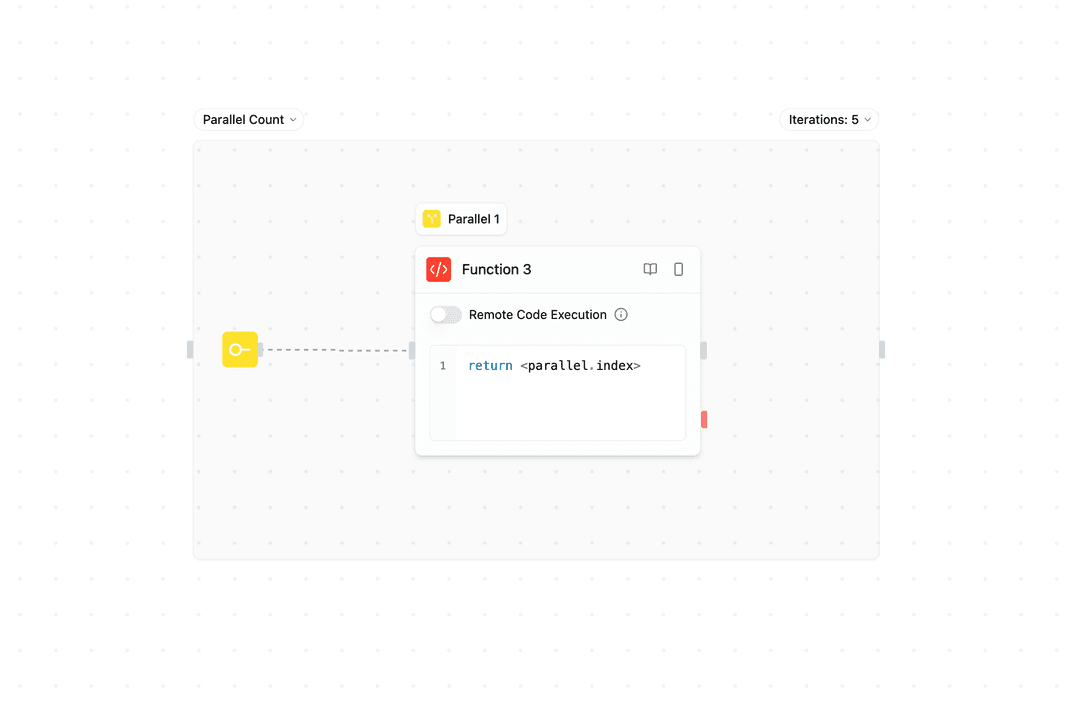
Use this when you need to run the same operation multiple times concurrently.
Example: Run 5 parallel instances
- Instance 1 ┐
- Instance 2 ├─ All execute simultaneously
- Instance 3 │
- Instance 4 │
- Instance 5 ┘
Collection-based Parallel - Distribute a collection across parallel instances:
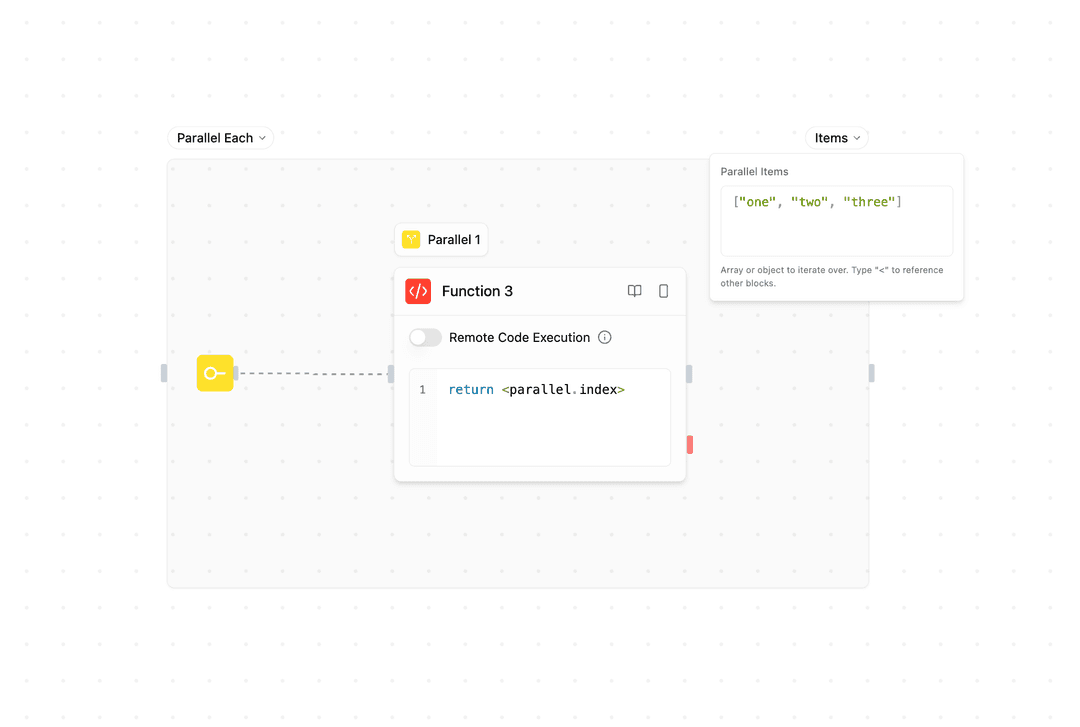
Each instance processes one item from the collection simultaneously.
Example: Process ["task1", "task2", "task3"] in parallel
- Instance 1: Process "task1" ┐
- Instance 2: Process "task2" ├─ All execute simultaneously
- Instance 3: Process "task3" ┘
How to Use Parallel Blocks
Creating a Parallel Block
- Drag a Parallel block from the toolbar onto your canvas
- Configure the parallel type and parameters
- Drag one or more blocks inside the parallel container, connecting them to each other if needed
- Every block inside runs once per branch
Accessing Results
After a parallel block completes, you can access aggregated results:
<parallel.results>: Array of results from all parallel instances
Example Use Cases
Batch API Processing
Scenario: Process multiple API calls simultaneously
- Parallel block with collection of API endpoints
- Inside parallel: API block calls each endpoint
- After parallel: Process all responses together
Multi-Model AI Processing
Scenario: Get responses from multiple AI models
- Collection-based parallel over a list of model IDs (e.g., ["gpt-4o", "claude-3.7-sonnet", "gemini-2.5-pro"])
- Inside parallel: Agent's model is set to the current item from the collection
- After parallel: Compare and select best response
Advanced Features
Result Aggregation
Results from all parallel instances are automatically collected:
// In a Function block after the parallel
const allResults = input.parallel.results;
// Returns: [result1, result2, result3, ...]
Instance Isolation
Each parallel instance runs independently:
- Separate variable scopes
- No shared state between instances
- Failures in one instance don't affect others
Limitations
Container blocks (Loops and Parallels) cannot be nested inside each other. This means:
- You cannot place a Loop block inside a Parallel block
- You cannot place another Parallel block inside a Parallel block
- You cannot place any container block inside another container block
While parallel execution is faster, be mindful of:
- API rate limits when making concurrent requests
- Memory usage with large datasets
- Maximum of 20 concurrent instances to prevent resource exhaustion
Parallel vs Loop
Understanding when to use each:
| Feature | Parallel | Loop |
|---|---|---|
| Execution | Concurrent | Sequential |
| Speed | Faster for independent operations | Slower but ordered |
| Order | No guaranteed order | Maintains order |
| Use case | Independent operations | Dependent operations |
| Resource usage | Higher | Lower |
Inputs and Outputs
Parallel Type: Choose between 'count' or 'collection'
Count: Number of instances to run (count-based)
Collection: Array or object to distribute (collection-based)
parallel.currentItem: Item for this instance
parallel.index: Instance number (0-based)
parallel.items: Full collection (collection-based)
parallel.results: Array of all instance results
Access: Available in blocks after the parallel
Best Practices
- Independent operations only: Ensure operations don't depend on each other
- Handle rate limits: Add delays or throttling for API-heavy workflows
- Error handling: Each instance should handle its own errors gracefully